
How do benthic organisms withstand and utilize moving water?
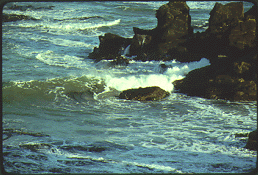
Many aquatic animals and plants spend part of their lives anchored to the substratum as water flows by. We have been studying the hydrodynamics of such sessile organisms to reveal the mechanisms by which they can affect the magnitude of the flow-induced forces they encounter in different habitats. We have also been studying body designs to analyze how they affect the distribution and magnitude of the mechanical stresses experienced when these organisms are subjected to hydrodynamic forces. In addition, we have been analyzing how the mechanical properties of the skeletal tissues of such organisms affect how much they deform and whether or not they break in response to flow-induced stresses. Our studies have focused on a variety of organisms (ranging from kelp and seagrasses to cnidarians and tunicates) living in diverse habitats (ranging from wave-swept rocky shores and coral reefs to estuaries).
Benthic organisms depend on the water moving around them for the transport to their vicinity of dissolved substances (e.g. gases, nutrients, chemical signals) and particulate food, for the removal of wastes, for the transport and mixing of gametes (of spawners) and for the dispersal of propagules (e.g. planktonic larvae, spores). We have been studying the transport and mixing of water-borne materials in a variety of habitats, ranging from wave-swept rocky shores and coral reefs to calm estuaries and lagoons. We have focused on the scale of water flow affecting individual organisms (e.g. mm's to m's), and on biological issues ranging from larval dispersal to food or nutrient supply. Our present research focuses on the effects of seaweed and seagrass canopies on water flow, and on the dispersal of olfactory cues and larvae in coral reef environments.
Selected references on this topic
- Koehl, M. (text) and A. R. Wertheim (photographs) (2006) Wave-Swept Shore. University of California Press.
- Koehl, M. A. R. (1982) The interaction of moving water and sessile organisms. Scientific American 247: 124-132. (overview)
- Koehl, M. A. R. (1976) Mechanical design in sea anemones. pp. 23-31, In G. O. Mackie [ed.], Coelenterate Ecology and Behavior. Plenum Publishing Corp.
- Wainwright, S. A. and M. A. R. Koehl (1976) The nature of flow and the reaction of benthic cnidaria to it. pp. 5-21. In G. O. Mackie [ed.], Coelenterate Ecology and Behavior. Plenum Publishing Corp.
- Koehl, M. A. R. (1977) Effects of sea anemones on the flow forces they encounter. J. Exp. Biol. 69: 87-105.
- Koehl, M. A. R. (1977) Mechanical organization of cantilever-like sessile organisms: Sea anemones. J. Exp. Biol. 69: 127-142.
- Koehl, M. A. R. (1977) Mechanical diversity of the connective tissue of the body wall of sea anemones. J. Exp. Biol. 69: 107-125.
- Koehl, M. A. R. (1977) Water flow and the morphology of zoanthid colonies. Proc. Third Int. Coral Reef Symp. I. Biology, pp. 437-444.
- Koehl, M. A. R. and S. A. Wainwright (1977) Mechanical design of a giant kelp. Limnol. Oceanogr. 22: 1067-1071.
- Woodley, J. D., et. al. (1981) Hurricane Allen's impact on Jamaican coral reefs. Science 214: 749-755.
- Koehl, M. A. R. (1982) Mechanical design of spicule-reinforced connective tissues: Stiffness. J. Exp. Biol. 98: 239-268.
- Sebens, K. P. and M. A. R. Koehl (1984) Predation on zooplankton by two benthic anthozoans, Alcyonium siderium (Alcoynacea) and Metridium senile (Actiniaria), in the New England subtidal. Mar. Biol. 81: 255-271.
- Koehl, M. A. R. (1984) How do benthic organisms withstand moving water? Amer. Zoologist 24: 57-70.
- Denny, M. W., T. Daniel, and M. A. R. Koehl (1985) Mechanical limits to the size of wave- swept organisms. Ecol. Monogr. 55: 69-102.
- Koehl, M. A. R. and S. A. Wainwright (1986) Biomechanics. pp. 292-313, In M. L. Littler and D. S. Littler [eds.], Handbook of Phycological Methods. Ecological Field Methods: Macroalgae. Cambridge University Press.
- Koehl, M. A. R. (1986) Seaweeds in moving water: Form and mechanical function. pp. 603-634, In T. J. Givnish [ed.], On the Economy of Plant Form and Function. Cambridge University Press.
- Koehl, M. A. R. and R. S. Alberte (1988) Flow, flapping, and photosynthesis of macroalgae: Functional consequences of undulate blade morphology. Mar. Biol. 99: 435-444.
- Holbrook, N. M., M. Denny and M. A. R. Koehl. (1991) Intertidal "trees": Consequences of aggregation on the mechanical and photosynthetic characteristics of sea palms. J. Exp. Mar. Biol. Ecol. 146: 39-67.
- Johnson, A. J. and M. A. R. Koehl (1994) Maintainence of dynamic strain similarity and environmental stress factor in different flow habitats: Thallus allometry and material properties of a giant kelp. J. Exp. Biol.195: 381-410.
- Koehl, M. A. R., T. M. Powell, and E. L. Dobbins (1997) Effects of algal turf on mass transport and flow microhabitat of ascidians in a coral reef lagoon. Proc. 8th Int. Coral Reef Symp. 2: 1087-1092.
- Koehl, M. A. R. (1998) Physiological, ecological, and evolutionary consequences of the hydrodynamics of individual organisms. OEUVRE, (published electronically) link to article
- Martinez, M. M., R. J. Full, and M. A. R. Koehl (1998) Underwater punting by an intertidal crab: A novel gait revealed by the kinematics of pedestrian locomotion in air vs. water. J. Exp. Biol. 201: 2609-2623.
- Koehl, M. A. R. (1998) The quirks of jerks. Nature 396: 621-623.
- Edlund, A. F. and M. A. R. Koehl. (1998) Adhesion and reattachment of compound ascidians to various substrata. J. Exp. Biol. 201: 2397-2402
- Koehl, M. A. R. (1999) Ecological biomechaincs: Life history, mechanical design, and temporal patterns of mechanical stress. J. Exp. Biol. 202: 3469-3476.
- Koehl, M. A. R. (2000) Mechanical design and hydrodynamics of blade-like algae: Chondracanthus exasperatus. pp. 295-308, In, Proc. Third Internat. Plant Biomechanics Conf. H. C. Spatz and T. Speck [eds.], Thieme Verlag, Stuttgart.
- Koehl, M. A. R., B. Helmuth and R. Carpenter (2001) Growing and Flowing, pp. 17-29 In, The Algorithmic Beauty of Seaweeds, Sponges and Corals. J. A. Kaandorp and J. E. Kubler [eds.], Springer-Verlag, Heidelberg.
- Gaylord, B., M. W. Denny and M. A. R. Koehl (2003) Modulation of wave forces on kelp canopies by alongshare currents. Limnol. Oceanogr. 48: 860-871.
- Koehl, M. A. R. (2003) Physical modelling in biomechanics. Phil Trans. Roy. Soc. Lond. B. 358: 1589-1596.
- Koehl, M. A. R., P. Jumars, and L. Karp-Boss (2003) Algal Biophysics. pp. 115-130 In Out of the Past: Collected Reviews to Celebrate the Jubilee of the British Phycological society. T. A. Norton [ed.], Belfast: The British Phycological Society.
- Koehl, M. A. R. (2003) Physical modelling in biomechanics. Phil Trans. Roy. Soc. Lond. B 358: 1589-1596.
- Fonseca, M. S. and M. A. R. Koehl. (2006) Flow in seagrass canopies: The influence of patch width. Est. Coastal Shelf Sci. 67: 1-9.
- Fonseca, M. S., M. A. R. Koehl and B. S. Kopp. (2007) Biomechanical factors contributing to self-organization in seagrass landscapes. J. Exp. Mar. Biol. Ecol. 340: 227-246.
- Stewart, H. L., C. E. Payri and M. A. R. Koehl. (2007) The role of buoyancy in mitigating reduced light in macroalgal aggregations. J. Exp. Mar. Biol. Ecol. 343: 11-20.
- Koehl, M. A. R. , W. K. Silk, H. Liang, and L. Mahadevan. (2008) How kelp produce blade shapes suited to different flow regimes: A new wrinkle. Integr. Comp. Biol. 48: 318-330.
- Gaylord, B., M.W. Denny, and M.A.R. Koehl. (2008) Flow forces on seaweeds: Field evidence for roles of wave impingement and organism inertia. Biol. Bull. 215 : 295-308.
- Koehl, M. A. R. (2010) How does morphology affect performance in variable environments? In: In search of the causes of evolution. From field observations to mechanisms. P.R. Grant and B. Grant [eds.] Princeton University Press, pp. 177-191.
- Robinson, H.E., C. M. Finelli, and M. A. R. Koehl (2013) Interactions between benthic predators and zooplanktonic prey are affected by turbulent waves. Integrative Biology 53: 810-820.
- Burnett, N. P. and M. A. R. Koehl. (2018) Knots and tangles weaken kelp fronds while increasing drag forces and epifauna on the kelp. J. Exp. Mar. Biol. Ecol. 508: 13 - 20.
- Burnett, N.P and M.A.R. Koehl (2019) Mechanical properties of the wave-swept kelp Egregia menziesii change with season, growth rate and herbivore wounds . J. Exp. Biol. 222: doi:10.1242/jeb.190595
- Fonseca, M.S, J.W. Fourqurean, M.A.R. Koehl (2019) Effect of seagrass on current speed: Importance of flexibility versus shoot density. Frontiers in Marine Science 6: 376. doi: 10.3389/fmars.2019.00376
- Burnett, N. P. and M. A. R. Koehl (2020) Thallus pruning does not enhance survival or growth of a wave-swept kelp. Marine Biology 167: 52. doi. org/10.1007/s00227-020-3663-5.
- Burnett, N. P. and M. A. R. Koehl (2021) Age affects the strain-rate dependence of mechanical properties of kelp tissues. American Journal of Botany 108: 769-776. doi.org/10.1002/ajb2.1662
- Pepper, R. E., E. E. Riley, M. Baron, T. Hurot, L. T. Nielsen, M. A. R. Koehl, T. Kiørboe, A. Andersen (2021) The effect of external flow on the feeding currents of sessile microorganisms. J. Roy. Soc. Interface. 18: 20200953. https://doi.org/10.1098/rsif.2020.0953
- Koehl, M. A. R and W. K Silk (2021) How kelp in drag lose their ruffles: Environmental cues, growth kinematics, and mechanical constraints govern curvature. Journal of Experimental Botany 72: 3677-3687. doi.org/10.1093/jxb/erab111
- Koehl, M. A. R. (2022) Ecological biomechanics of marine macrophytes. Journal of Experimental Botany 73: 1104–1121. doi.org/10.1093/jxb/erab536
- Koehl, M. A. R. and T. L. Daniel (2022) Hydrodynamic interactions between macroalgae and their epibionts. Frontiers in Marine Science: Local Hydrodynamics of Benthic Marine Organisms. 9: 872960. doi.org/10.3389/fmars.2022.872960
- Burnett, N. P. and M. A. R. Koehl (2022) Ecological biomechanics of damage to macroalgae. Frontiers in Plant Science 13:981904. doi.org/10.3389/fpls.2022.981904
- Koehl, M. A. R. (2023) Of corpses, ghosts, and mirages: Biomechanical consequences of morphology depend on the environment. J. Exp. Biol. 226: jeb245442. doi:10.1242/jeb.245442
- Koehl, M. A. R. (2024) A life outside. Annual Review of Marine Science 16: 17.1–17.23 doi/abs/10.1146/annurev-marine-032223-014227
Links to Specific Topics
- Fluid dynamics of hairy little legs
- Microscopic organisms swimming in turbulent flow/Larval Settlement
- Fluid dynamics of odor capture by olfactory antennae
- Selective factors in the evolution of multi-cellularity
- Biomechanics of hydrostatic skeletons
- Biomechanics of morphogenesis
- Evolution of novel function / Consequences of body size
- Fluid dynamics of animals at intermediate Re